

Ireland's Gambling Law in 2026: What GRAI Just Changed

We have paid partnerships with the online casino operators featured on our site. We may also earn commissions when users click on certain links. However, these partnerships do not affect our reviews, recommendations, or analysis. We remain impartial and committed to delivering unbiased gambling content.
Learn moreIreland’s gambling market is undergoing its biggest reform in decades. For nearly a century, the Betting Act of 1931 governed everything, built to collect tax, not protect players. That changed with GRAI, Ireland’s first dedicated gambling regulator.
This guide covers what’s changed, key deadlines, your new protections, and how winnings are taxed, plus a quick UK comparison and answers to common licensing questions.
All info is verified against official sources: the GRAI platform, the Department of Justice, and the legislation itself.
- Ireland’s Regulatory Status at a Glance (July 2026)
- From Regulatory Gap to GRAI: What Actually Changed
- The Transition Away from Legacy Licensing
- Player Protection Under the New Regime
- Tax on Winnings: Still Unchanged
- Ireland vs the UK: Two Different Approaches
- The Bottom Line for Players
- How We Verified This
Ireland’s Regulatory Status at a Glance (July 2026)
We’ve been closely following everything happening in Ireland this year, and honestly, it’s hard to keep up with the changes. We did that for you! Here’s a quick rundown of what’s actually going on:
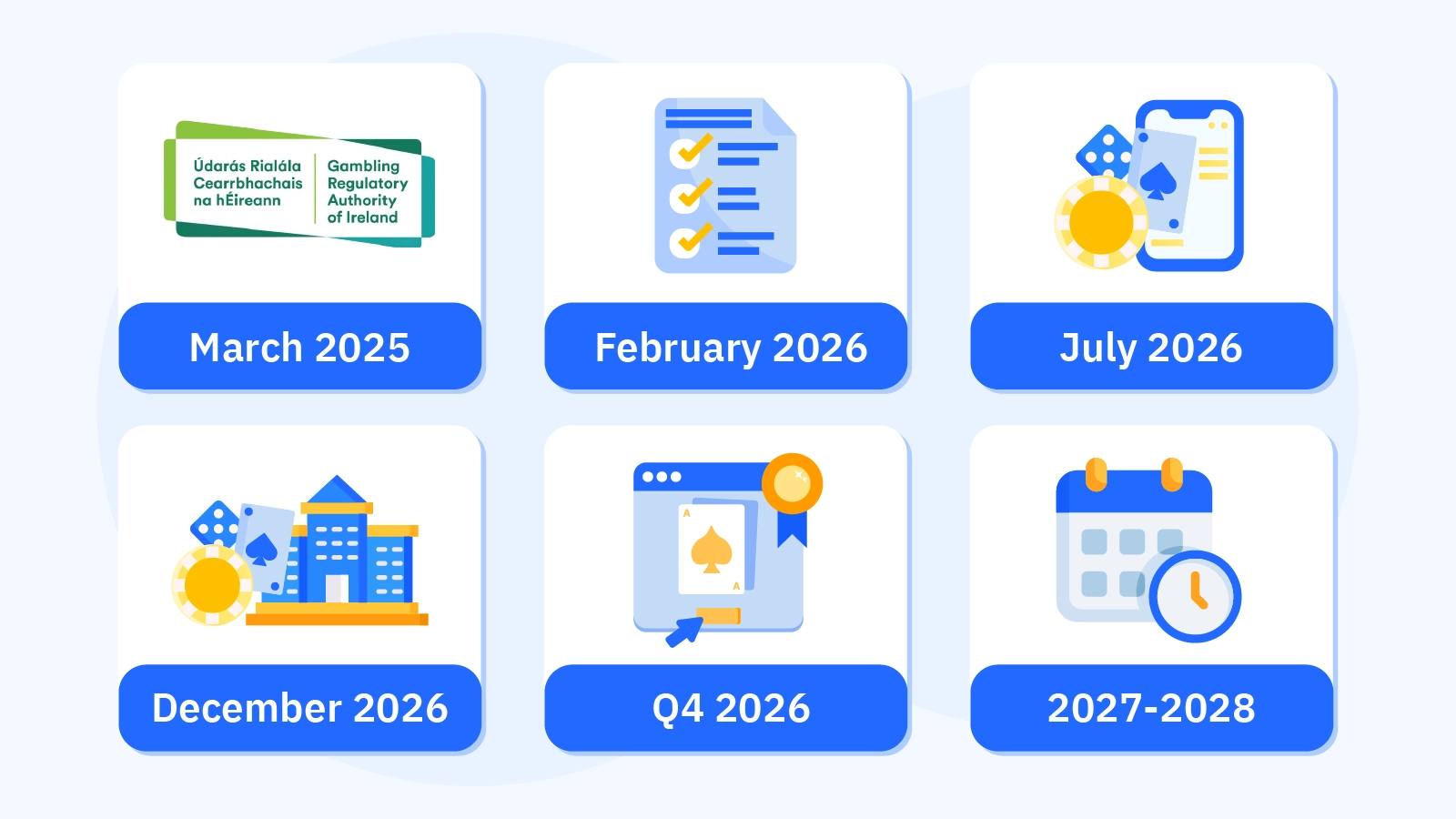
GRAI, the body under the Department of Justice, will be responsible for this sector. It will operate under the Gambling Regulation Act 2024. Although the institution has existed since March 2025, the licensing process only started in February 2026.
Which Licences Are Live So Far?
As of July, licences for remote betting have been issued, and in-person betting licences followed in December. Online casinos aren’t included yet, but we believe that will change later this year. Other categories, like lotteries, will be rolled out gradually through 2027-2028.
As for the stakes, operators who don’t follow the rules will face fines of up to EUR 20 million or 10% of turnover. As a player, you don’t need to worry about taxes. Winnings stay tax-free, as long as you’re playing recreationally!
So Ireland is still mid-process, with more licensing categories set to roll out through 2028. Our CasinoAlpha specialists will keep adding new information in real time, so don’t forget to check back on our site to stay up to date.
From Regulatory Gap to GRAI: What Actually Changed

Ireland’s old legal framework was built on the Betting Act of 1931, later amended in 2015, which allowed betting agencies to apply for a remote bookmaker’s licence. This licence let them collect betting duty, but it offered players no real protection whatsoever.
For casino games, things were even worse! There was no national licence at all. An operator offering slots, blackjack or roulette to Irish players usually held a licence from another jurisdiction, MGA, for example. But there was no Ireland-specific authorisation in place.
Two Decades of Failed Reform Attempts
Unfortunately, this situation dragged on for almost two decades. The online gambling market kept growing, and numerous gambling reform bills were proposed along the way. None of them made it through, and the old 1931 framework stayed in force.
What we’re really talking about here is a legislative gap, not some formal EU-level recognition agreement. The Gambling Regulation Act 2024 replaces that entire structure. GRAI can now license, inspect and penalise every form of gambling in Ireland, whether we’re talking about physical casinos or online ones.
The Transition Away from Legacy Licensing
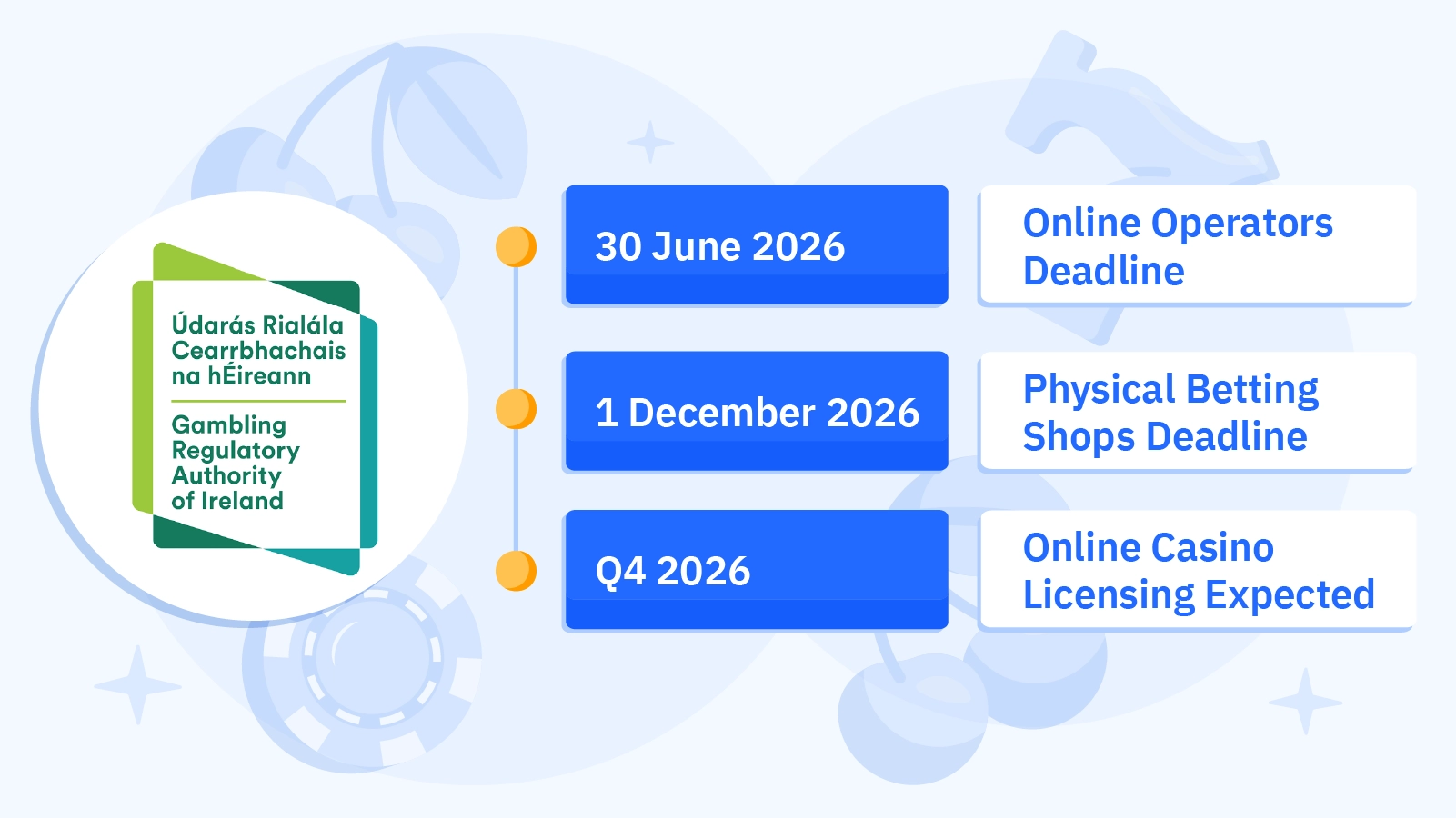
All licences issued by the Revenue Commissioners were renewed for one final one-year term, meaning they expired on 30 June 2026. After this date, all operators looking to run online must obtain a GRAI licence.
Physical betting shops follow the same pattern, but their deadline was 1 December 2026, the date when their Revenue authorisations expired. Operators who miss the deadline without holding a GRAI licence will completely lose the legal basis to accept customers from Ireland. Unlike the old system, the rules here are much tougher.
Where Online Casinos Stand in the Transition
The situation with online casino games is a bit different. There was never a national licence for this category, so there’s no Irish licence set to expire. Most operators are already licensed by MGA. However, they will soon need a GRAI licence to be able to operate in the Irish market.
Until GRAI publishes its register of licensed gaming operators, you as a player won’t be able to verify whether a casino holds an Ireland-specific licence, simply because it doesn’t exist yet. Industry estimates suggest this licence category will appear around Q4 2026, but no official date has been confirmed yet. So treat this as an estimate, not something set in stone.
Player Protection Under the New Regime
The Gambling Regulation Act 2024 introduces a lot of changes. There are protections that go beyond what the old system required. These include:
- Advertising watershed: Gambling ads are banned on television and radio between 5:30am and 9pm.
- Social media restrictions: If you receive ads, you must already have an account with that casino or already follow it.
- Ban on VIP programs or personalised bonuses: If you show signs of excessive gambling, the casino must not offer you personalised bonuses. These offers must be made available to the general public, not to a single individual.
- Ban on credit cards or other forms of credit for funding gambling.
- A national self-exclusion register: You can exclude yourself from a single casino or from all of them at once. This program is set to be launched under GRAI’s authority.
Tax on Winnings: Still Unchanged
The good news is that nothing changes for you as a player. The new law won’t change how your casino winnings are taxed. If you win money from gambling, whether it’s betting, casino games, or the lottery, you remain exempt from income tax, no matter how much you’ve won.
The new legal framework only changes how operators are licensed and supervised, while also introducing new fees and obligations for them. Your tax situation as a player stays exactly the same! We guarantee this ourselves, the experts on the CasinoAlpha team.
Ireland vs the UK: Two Different Approaches
Ireland’s new legal framework and the UK’s are quite close when it comes to regulation. Even so, they remain fairly different in structure.
The UK Gambling Commission has had a full licensing regime for online casinos for a long time now over a decade! GRAI, on the other hand, is rolling out its licensing categories gradually, one at a time.
So what does this tell us? The two markets offer players different levels of licensing, especially when it comes to casino-style games. That said, both apply equally strict rules when it comes to player protection!
| Category | Ireland (GRAI) | United Kingdom (UKGC) |
|---|---|---|
| Regulator | Live since March 2025, still finding its feet | The old guard, nothing new here |
| Player tax | Tax-free | Same, tax-free |
| What operators pay | 2% duty, plus a GRAI fee around EUR 20k | Ouch: 40% Remote Gaming Duty starting April 2026, General Betting Duty at 15% now, 25% from 2027 |
| Online casinos | Category doesn’t exist yet, maybe Q4 2026 | Been mandatory for years |
| Ads | Actual law: no ads 5:30am-9pm | Just an industry promise (whistle-to-whistle), not law |
| Self-exclusion | Coming soon, national register | GAMSTOP’s been the standard for a while, 6-month minimum |
| Worst-case penalty | EUR 20 million or 10% of turnover, whichever’s worse | They just pull your licence |
One thing’s clear: Ireland’s still got a long way to go, you can see that for yourself. We’ll keep you posted on the latest updates! Check back on our site every week so you don’t miss anything!
The Bottom Line for Players
As you can see, Ireland’s gambling regulation framework has moved forward quickly, faster than analyses from a year ago expected. GRAI is a real, fully functional regulator that can hand out fines reaching into the tens of millions of euros. Along with GRAI come advertising restrictions, and, in the near future, a national self-exclusion register.
If you play sports betting, we’d advise you to always check whether the operator you play with holds a valid GRAI licence. For casino games, no such licence exists yet, for now. So you can still choose operators with foreign licences, MGA for example.
Whatever type of game you play, gambling should stay a form of entertainment, not a way to make money. The fact that you don’t pay tax on winnings doesn’t change the financial risk that comes with losses in any way.
The dates in this guide may change as GRAI opens new licensing categories over the next two years. Keep an eye on our site, and we’ll keep you updated once GRAI officially confirms the launch date for online casinos.
How We Verified This
To put this guide together, our CasinoAlpha team consulted GRAI’s official platform directly. We didn’t stop there! We also checked Department of Justice press releases. We carefully went through the Gambling Regulation Act 2024, the Revenue Commissioners’ guidance, and established legal industry sources.
We believe the next 18 months will be decisive for Ireland’s gambling market. As GRAI opens the online gaming category and publishes its first complete register of licensed operators, players will have, for the first time, a clear and official way to check whether a casino meets Irish standards.
Until then, we have just one piece of advice for you: do your research before you play! Always check the operator’s licence, whether it’s issued by GRAI or a foreign authority. On our site, you’ll always find only licensed casinos.
F.A.Q.
Is online gambling legal in Ireland right now?
Yes, sports betting is perfectly legal in Ireland, especially now with the GRAI licensing system in place. Online casino games aren’t banned either, but there’s no dedicated Irish licence for this type of gambling yet. Most casinos offering these games hold a different kind of licence.
Does Ireland have its own gambling regulator?
Yes, GRAI has been up and running since March 2025, and as of 1 July 2026 it started issuing operating licences for remote betting.
Do I have to pay tax on gambling winnings in Ireland?
No, you don’t! Winnings from sports betting, casino games or the lottery are tax-free under current Irish tax law. Don’t worry, the new regulation won’t change this, you don’t have to pay any tax.
When will online casinos get their own Irish licence?
GRAI doesn’t have a licence for the online casino/gaming category yet. According to industry reports, this is expected to change around Q4 2026. We believe fully licensed operators will start appearing by late 2026 or early 2027.
What happens to operators that only hold an MGA or UK licence?
For sports betting, a foreign licence won’t be enough anymore. As of 1 July 2026, operators need a GRAI licence. On the flip side, there’s no GRAI licence yet for casino games. So operators with a foreign licence can keep operating in the Irish market for now.