MGA Fees Could Double by 2028: The Operator Exodus Risk

We have paid partnerships with the online casino operators featured on our site. We may also earn commissions when users click on certain links. However, these partnerships do not affect our reviews, recommendations, or analysis. We remain impartial and committed to delivering unbiased gambling content.
Learn moreHave you heard of the MGA? If you play at a licensed casino, you’ve definitely seen this logo in the footer. The Malta Gaming Authority is one of the most respected regulatory bodies in the industry, and we at CasinoAlpha believe that MGA licensing fees will double by 2028. Let’s take a look below at the reasons why we think this change will happen.
- What MGA Licence Fees Look Like Today
- The Forecast: Current vs. Predicted (2028)
- Why a Fee Increase Is Likely
- Why It Might Not Happen (The Honest Case Against)
- Forecast Timeline
- What It Would Mean for Players
- What to Do Today
- Sources
What MGA Licence Fees Look Like Today
As a player, you’re probably wondering why it matters how much a casino pays for its MGA license. The truth is it really does mater. That’s because these costs affect the quality of the site where you play.
Currently, an MGA-licensed operator pays three types of fees: a €5,000 application fee, an annual fee of €25,000 and a variable contribution based on its revenue. This can amount to up to €600,000 per year!
What does this tell us? The total cost for a casino ranges from 40,000 euros to over 600,000 euros! On top of that, there are expenses for infrastructure, staff, and other costs. So, clearly, the budget is increasing.
The Forecast: Current vs. Predicted (2028)
The editor of this article, Adelina Paraschiv, has also prepared a table showing what an approximate 100% increase in the fee structure would look like. Keep in mind that this is just a scenario, okay? It’s not an official announcement from the MGA!
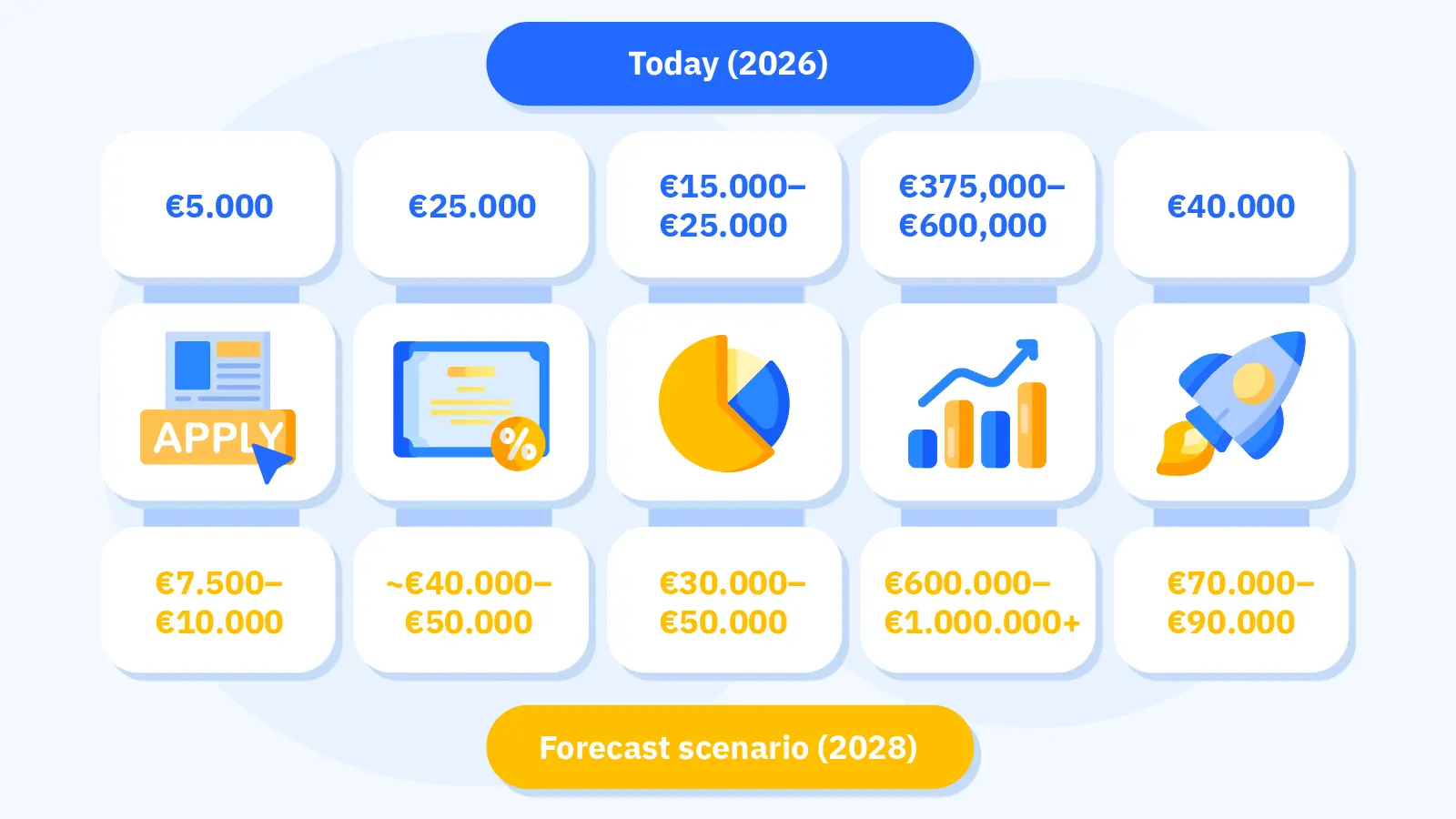
| Cost component | Today (2026) | Forecast scenario (2028) |
|---|---|---|
| Application fee | €5.000 | €7.500–€10.000 |
| Fixed annual licence fee | €25.000 | ~€40.000–€50.000 |
| Compliance contribution (min) | €15.000–€25.000 | €30.000–€50.000 |
| Compliance contribution (max) | €375,000–€600,000 | €600.000–€1.000.000+ |
| Effective small-operator floor | €40.000 | €70.000–€90.000 |
These are just our estimates, from the CasinoAlpha team. Our confidence level is 70%. It remains to be seen if we’re right!
Why a Fee Increase Is Likely
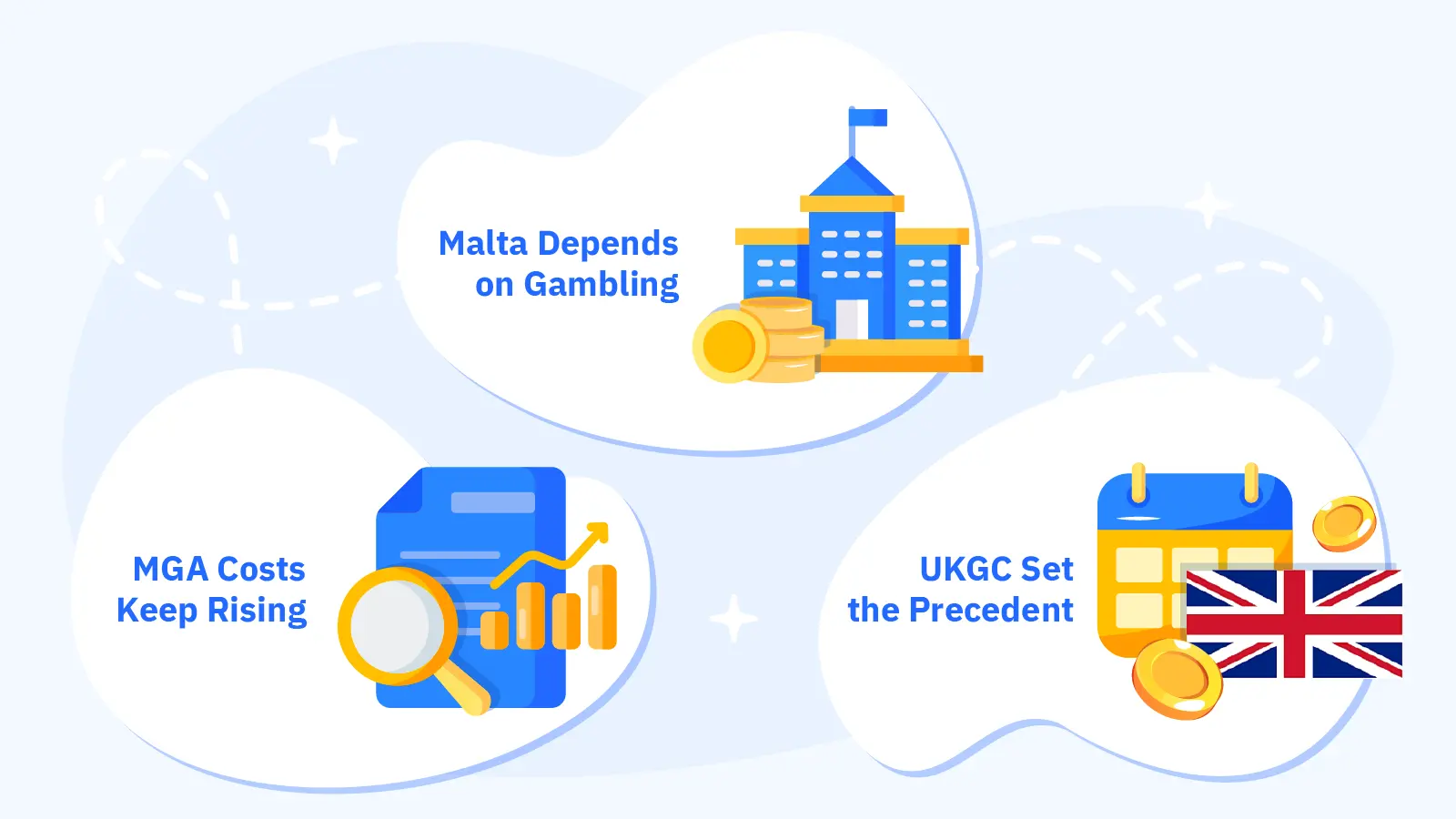
Why do we think taxes will go up? It’s no secret and we’re certainly not the only ones who believe this. There are several reasons that suggest this is what will hapen.
Malta relies on revenue from gambling that much is clear. This sector directly accounts for approximately 6-8% of the economy. If we also consider the indirect effects, that figure can rise to 12%, since gabling also provides many jobs. There are over 10.000 people employed in this sector.
I’ve also noticed that the MGA’s costs have continued to rise. There are more licensees, much stricter AML standards and all of that costs money. We also have a clear precedent. The UK Gambling Commission did exactly the same thing. It raised fees by 55%! It didn’t stop there, and some time later it requested another increase, citing budget deficits.
Why It Might Not Happen (The Honest Case Against)
To understand why our confidence level hovers around 70% and no higher we have a few more important points to share.
The main argument is price. Malta competes directly with the United Kingdom and Gibraltar, right? It’s trying to attract as many gambling operators as possible, and that’s precisely Malta’s advantage. A license costs much less here!
What would happen if there were a sudden increase in fees? That very advantage would disappear. For example, a standard fee in Gibraltar is 100,000 pounds. Thats much more than a license costs in Malta.
There’s also the risk that smaller operators would leave and move to cheaper jurisdictions. Basically, Malta would risk losing too much money.
We’ve seen that there’s also internal political pressure. As I mentioned earlier, the gambling industry supports over 10,000 jobs in Malta. We have to acknowledge that it represents a significant part of the country’s economy.
Forecast Timeline
None of this happens overnight. However, we’re talking about a major change. So there will certainly be several stages before it becomes a reality. Here’s what we think this change will look like:
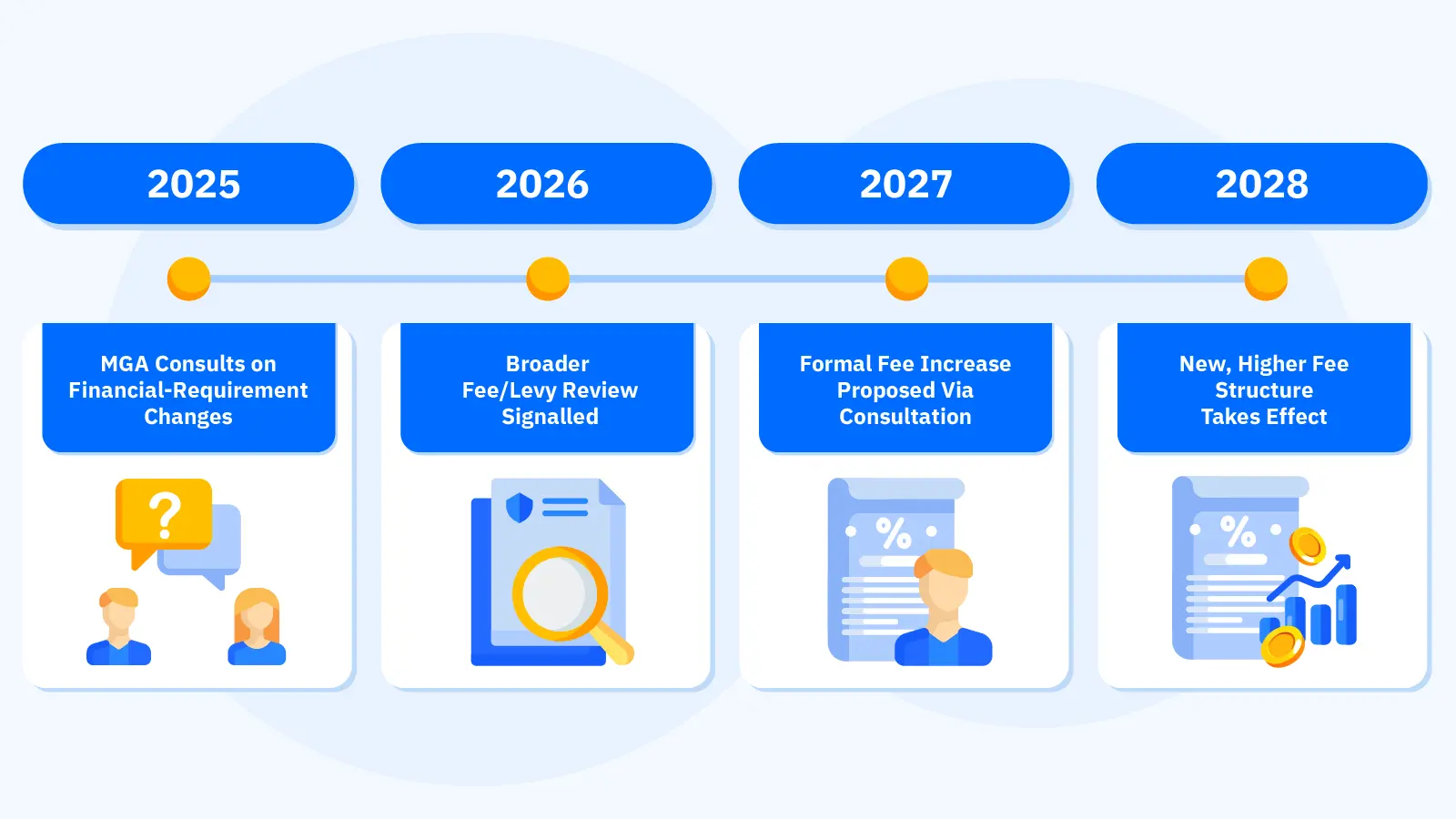
| When | What | Status |
|---|---|---|
| 2025 | MGA consults on financial-requirement changes | Observed |
| 2026 | Broader fee / levy review signalled | Forecast |
| 2027 | Formal fee increase proposed via consultation | Forecast |
| 2028 | New, higher fee structure takes effect | Forecast |
Only the 2025 step is confirmed; the rest is our projected path, okay?
What It Would Mean for Players
If MGA fees increase, small casinos would be the first to be affected. They’re already operating on a slim profit margin. It’s clear that they’re the most at risk of closing down or moving to other jurisdictions. How will this affect you? There will be fewer casinos to sign up with that much is clear.
In addition, the extra costs don’t just disappear. One way or another, they’ll end up being passed on to the players that is, to you! This would mean that operators remaining in the market would offer much smaller bonuses and higher wagering requirements. Don’t worry the RTP won’t be affected because it’s set by the game provider, not the casino.
As I mentioned above, there’s a risk that some brands might give up their MGA license and opt for a cheaper one. What does this mean for you? Less protection! On the other hand, the major operators, who will still be able to afford an MGA license, will prove that you can trust them. There will be far fewer MGA-licensed casinos, but they’ll be more financially stable and safer!
What to Do Today
There’s no need to rush and switch casinos right now. Nothing has changed yet! The MGA-licensed casino where you play is just as safe as it was yesterday. You need to understand that the MGA license is an indicator of quality, not a permanent guarantee.
Don’t forget to alway check that the casino has an MGA license. Unfortunately I’ve seen operators quietly switch their license to one from Curacao. What does that mean for you? Less protection!
Don’t let bonuses fool you either. A high value doesn’t automatically mean a good bonus. Check the terms of the offer, and only then can you decide whether or not it’s a good one. If you’re not sure which bonus to choose, we’re here to help! On our website, you’ll find plenty of offers to choose from.
Sources
- Malta Gaming Authority, Guidance Note: Licence Fees and Taxation (Gaming Licence Fee Regulations, S.L. 583.03). https://www.mga.org.mt/app/uploads/Guidance-Note-Licence-Fees-and-Taxation-1.pdf
- Malta Gaming Authority, Regulatory Updates. https://www.mga.org.mt/category/regulatory-updates/
- iGaming Business, UK government consultation on increased licence fees. https://igamingbusiness.com/legal-compliance/uk-government-consultation-increased-licence-fees/
- CSB Group, iGaming Tax and Licence Fees in Malta. https://www.csbgroup.com/igaming-services-malta/igaming-tax-licence-fees/
- SBC News, Malta looks to declare gaming tax of €67m by 2026. https://sbcnews.co.uk/europe/2025/10/28/malta-gaming-tax/
- UltraGlobal Licensing, Gibraltar vs Malta Gaming License: Cost & Setup Comparison. https://ultra-global.org/gibraltar-malta-license-comparison/
- The Malta Independent, Malta removed from FATF grey list (June 2022). https://www.independent.com.mt/articles/2022-06-15/local-news/Malta-removed-from-FATF-grey-list-6736243745
- iGEN, MGA Annual Report: iGaming at ~12% of Malta’s economy. https://igenorg.eu/press-releases/mga-annual-report/