



The UK Gambling Commission (UKGC): Complete Legal Guide to the World's Strictest Gambling Regulator
All the information in this page was checked by:

Every piece of information we present is rigorously verified by our team of experts using multiple credible sources, ensuring the highest level of accuracy and reliability.
We have paid partnerships with the online casino operators featured on our site. We may also earn commissions when users click on certain links. However, these partnerships do not affect our reviews, recommendations, or analysis. We remain impartial and committed to delivering unbiased gambling content.
Learn moreIn our newest legal guide, we will talk about the UK Gambling Commission because it is the most important regulatory body in the world. The UKGC set the gold standard because it combines players’ safety with a correct revenue generation approach for iGaming operators.
If you want to know how this authority works, when it was released, and why, keep reading this article because by the end of it, you will know exactly why UKGC casinos are the most reliable ones in the industry. As a bonus, our team of experts will show you the possible changes for 2030, so stay tuned.
- What Is the UK Gambling Commission? History and Authority
- Why the UKGC Is Considered the World’s Strictest Regulator
- The UKGC Licensing Framework: What Players Should Know
- Player Protection: GAMSTOP and Beyond
- How to File a Complaint Against a UKGC-Licensed Operator
- After Brexit: What Has Changed?
- The Future of UK Gambling Regulation (2026-2030)
- Conclusion
What Is the UK Gambling Commission? History and Authority
The UK Gambling Commission was established under the Gambling Act 2005 and began operating on 1 September 2007. Why was the UKGC needed?
The UK legislation replaced the old Gambling Board for Great Britain because the gambling laws had become outdated, and a new unified regulatory approach was needed, especially with the rise of online casinos and their subcategories, such as online bingo and online betting. Basically, when online casinos appeared, the legislation had to be changed, and this is what the UK did.
Keep in mind that the 2005 Act gave UKGC the right to license, regulate and enforce standards for all gambling activities in England, Scotland, and Wales. On top of that, on 1 Oct 2013, the Commission took over the National Lottery Commission, and this way it became the only regulator for gambling and the UK National Lottery.
Legal Goals
So, the UKGC has three legal pillars given by the Gambling Act 2005:
- It prevents gambling from being a source of crime and disorder
- Another goal is to make gambling based on fair play and transparency
- The last scope of the UKGC is to protect those vulnerable UK customers and also to protect children being exploited by gambling activities.
So, overall, you need to understand that the UKGC is not an average regulator where the only priority is revenue generation. On the contrary, UKGC protects while maintaining a gold standard, and the revenue generation is basically an effect based on a healthy approach to doing business.
Why the UKGC Is Considered the World’s Strictest Regulator
Complete Licensing Architecture
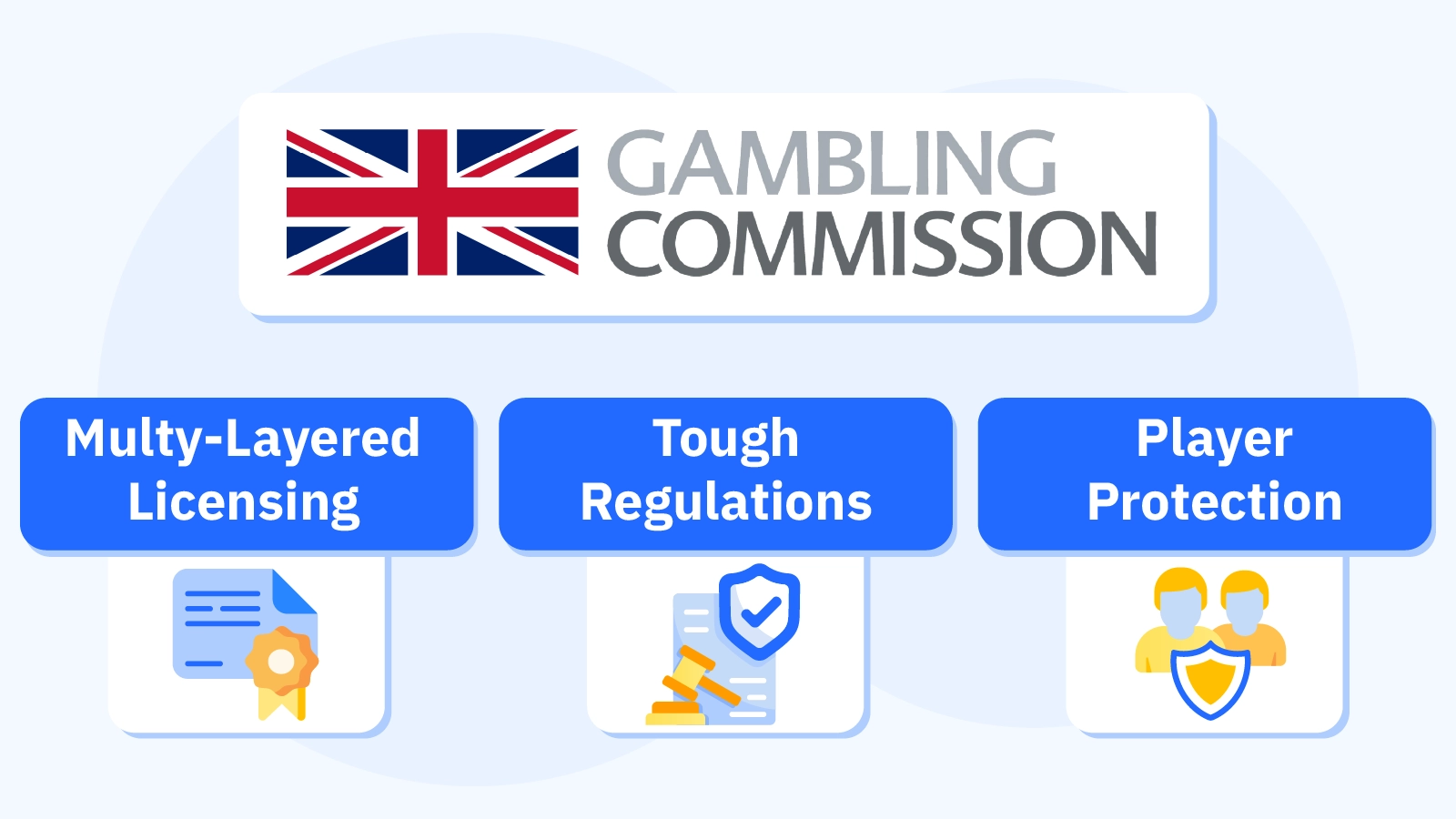
The reputation of the UKGC comes from the fact that it has a multi-layered licensing system, and the standards are more advanced than the international norms.
| Licence Type | Purpose | Complexity |
|---|---|---|
| Operating Licence | It gives approvals for gambling activities | High |
| Personal Management Licence (PML) | Personal authorization | Very High |
| Personal Functional Licence (PFL) | Approvals for specific roles | Moderate |
International Regulatory Comparison
- Versus Malta Gaming Authority (MGA): The MGA still gives strong licensing, but it lacks the UKGC’s necessary affordability tests, a centralised self-exclusion system and aggressive financial sanctions. For example, the UKGC usually fines £500,000, while MGA fines are lower. Find everything you should know about MGA in 2026 via our expert’s article.
- Versus Swedish/Danish Regulators: Sweden and Denmark opted for a similar UKGC-inspired approach, but they don’t force restrictions on game design, like spin speed limits or autoplay. Moreover, they haven’t implemented those extensive affordability checks, as the UKGC has.
Licence Conditions and Codes of Practice (LCCP)
The UKGC’s LCCP approach is one of the most complex structures for regulation globally, because it covers the following:
- Essential support for customers when harmful practices arise
- Strict AML verification to avoid money laundering
- Healthy marketing practices to safeguard vulnerable groups and children
- The customer funds are separated, so every player’s deposit is protected if the operators go bankrupt.
- Game design standards for betting limits, spin speeds, and feature restrictions
In 2024-2025, we saw that the UKGC gave £4.2 million in fines for 24 cases. Moreover, from October 2025, a new penalty framework was introduced, and the fines are 15% higher via the operator’s Gross Gambling Yield (GGY).
The UKGC Licensing Framework: What Players Should Know
Operating Licence Categories
Our team of experts saw that the UKGC gives licences to operate for the following:
- Online: Casino, betting sites, bingo, gaming software like NetEnt, and lottery
- Land-Based: Casino, bingo, betting, Adult Gaming Centre, Family Entertainment Centre, lottery
If you’re new and don’t know how to choose safe online casinos, don’t worry and read our newest article to find out more.
Why UKGC Licensing Matters to Players
There are advantages when you play at a UKGC-licensed casino:
- Your funds are safe: Your deposits are put in a different account from the operational funds of the casino. This method means your funds are protected even if the casino suddenly closes its doors.
- Fair gaming: Every RTP and RNG is tested by third-party groups such as iTechLabs, eCOGRA, etc. This means that there’s no room for unfair games. Don’t know what RTP means? We have a useful article for this, too.
- Free dispute resolution: You will not have to pay to go through dispute resolution because the complaints are free.
- GAMSTOP protection: A single registration at GAMSTOP will block you from all licensed casinos.
- Fair Marketing Standards: Thanks to this practice, there is no room for harmful marketing.
- Regulatory control: The UKGC itself will investigate complaints and will force operators to comply.
Licence Fees Structure (2025-2026)
| Licence Activity | Application Fee | Annual Fee Range |
|---|---|---|
| Remote Casino/Betting/Bingo | £2,670 | £6,600 – £220,000+ |
| Personal Management Licence | £1,165 | £120 (5-year validity) |
| Land-Based Casino | £1,800 – £11,000 | £1,800 – £22,000 |
Because of these high fees, only serious and well-capitalised operators can afford to be part of the UK market. This is a deliberate approach for entry to avoid underfunded operators with high risk for customers. [7]
Player Protection: GAMSTOP and Beyond

GAMSTOP: Mandatory Self-Exclusion Technology
GAMSTOP is a free, self-exclusion service that lets players block themselves from all UKGC casinos, and you can do it via a single registration [8]. This service was launched in April 2018, and by now, there are over 500,000 UK-registered residents [9].
How GAMSTOP Works:
- You must visit gamstop.co.uk and complete the online form
- You need to provide personal details such as name, address, DOB, email, and phone number
- You must select the exclusion period. The periods are 6 months, 1 year, or 5 years
- The activation is instant across all UKGC operators.
The GAMSTOP system has a complex identity matching system that will identify you by name, address, etc.
What Happens When You Register:
- The UKGC casinos receive your exclusion immediately.
- Every existing account will be closed in 24 hours.
- You cannot make new accounts after GAMSTOP is activated.
- All marketing communications stop
- You can’t reverse the exclusion ticket if the period hasn’t expired, which is a good thing because it gives you more time to reflect on the irresponsible spending on gambling.
GAMSTOP Limitations:
While GAMSTOP blocks UKGC casinos, it cannot prevent access to:
- Unlicensed offshore non-GAMSTOP operators
- Cryptocurrency casinos
- Casinos without UKGC approvals
From what we saw, the industry estimates suggest that 15%-20% of Gamstop participants will eventually play at unlicensed casinos, and this is a policy challenge because 100,000-150,000 UK residents did this already [10].
Enhanced Due Diligence and Affordability Checks
When a harm indicator is detected, the UKGC calls for a risk-based verification for customers via the following:
Affordability:
There’s a strong verification protocol when a customer experiences net losses that go beyond the acceptable limits, if there’s a behavioural change, if the credit request is increased or if there are signs of financial distress. So, the operators must know your income and how much you can afford for gambling.
What This Means for You:
If you lose amounts between £500 and £1000 + per month, the operators will:
- Ask for proof of income
- Ask about commitments
- Require a source of funds via documents
- Impose deposit limits if you can’t demonstrate the source of your funds.
Keep in mind that if you’re unable or unwilling to provide the evidence, the deposit limits will be between £100 and £500 monthly, so basically, you cannot have the perks of being a high roller.
Game Design Standards
Online Slot Guidelines (Effective May 2024):
- Every slot must have a 30-minute reality check where you can see the time played and how much you lose in that session.
- Autoplay feature is banned.
- Spin speed limits that prevent quick losses
- Restrictions on features create an illusion of control
Stake Limits:
- Fixed Odds Betting Terminals (FOBTs): £2 maximum per spin
- Land-based roulette: £100 maximum stake
How to File a Complaint Against a UKGC-Licensed Operator
Let’s look at a simplified version of how to file a complaint against UKGC casinos.
Your 3-Step Complaint Path
| Stage | How Long | What Happens |
|---|---|---|
| 1. Casino | Can take 8 weeks | You go directly to the operator and try to solve it there |
| 2. ADR | This can take 90 days | Free dispute resolution steps in if the casino didn’t help you. |
| 3. UKGC | As long as it’s needed | They look into the serious breaches, and they need multiple reports from different players. |
Step 1: Start With the Casino (You Have to Do This First)
Before anyone else can help, you need to complain directly to the casino. Every UKGC-licensed site must check out your complaint and respond within 8 weeks [14].
What people usually complain about:
- Delayed withdrawals
- Account closed or locked without warning
- Game outcome disputes
- Bonus terms changed after you claimed the promo
- Multiple verification requests without a clear reason
Keep screenshots of everything, such as terms, transactions, and chat logs. You’ll need them later if this doesn’t work.
Step 2: Take It to ADR (Free Dispute Resolution)
If you are ignored by the casino or if they refuse to fix the problem after 8 weeks, this is a serious issue, and you need to go to an ADR provider [15]. ADR providers are independent services that investigate and resolve disputes.
Which ADR handles your issue:
| Provider | What They Cover |
|---|---|
| IBAS | Sports betting issues, such as wrong odds, wrong events, etc. |
| CEDR | Casino games and slots |
| ADR4C | Payment and ID verification |
Keep in mind that ADR is free. They decide within 90 days, and about 35-40% of cases end with players getting paid.
You’ll Probably Win If:
Keep in mind that the chances of success when we refer to dispute resolution are higher when the mistake was made by the casino, with the following
- Wrong odds paid out on your bet
- Closed your account while you were verifying documents
- You encounter different bonus rules than those you saw in the terms for the first time
- The game had errors and took your funds
- If they keep your withdrawal for weeks without a reason
You Won’t Win If:
You will not see success in terms of dispute resolution if the mistake was not generated by the casino and if they used their legal rights, such as:
- Refused to let you play or closed your account (they can do this)
- You lost money playing normally
- You don’t like the odds or stake limits they set
- They put deposit limits on your account
Step 3: Report to the UKGC (Intelligence, Not Resolution)
Keep in mind that the UKGC will not fix individual complaints. However, if the casino didn’t respect the regulations, you can report it anonymously [14]:
So, your report will go into their database made for enforcement purposes. If there are multiple payers that report the same casino for the same or similar issue, the UKGC then starts to investigate the matter and can fine or close the casino. Unfortunately, you won’t hear back from them, but don’t forget that your report matters.
After Brexit: What Has Changed?

However, when the UKGC was in place, the United Kingdom was part of the EU, but from 2020 things have changed.
Regulatory Independence Post-EU Exit
The Brexit process, which was finalised on 31 December 2020, gave more power to the UKGC’s position:
- Independence: After Brexit, the UKGC gained more power because it was no longer bound to the EU directives.
- Extraterritorial Approach: If an iGaming operator wants to be part of the UK gambling community, it must have a UKGC licence.
- UKGC vs EU: The UK player protection is beyond the EU norms; they’re stricter and more efficient.
- Gibraltar/Malta Operators: Keep in mind that it’s not enough for a casino to be licensed by Gibraltar or MGA only. They need a UKGC licence, too.
The 2023 Gambling White Paper
Gambling Reform for the Digital Age saw a reform in April 2023. This reform included the affordability checks or source of income, a better protection for children, higher controls and limits on marketing, and they even reformed how the VIP system works in the UK in online casinos.
Implementation Timeline:
- May 2024: The first change is related to game design, namely the spin limits and the autoplay feature. If you play slot games in the UK from May 2024, you will not have the autoplay feature.
- November 2024: Strict verification requirements
- October 2025: New financial penalty system
- 2026+: Full affordability checks rules
Current Challenges (2026)
- Black Market Growth: Regrettably, 100,000-200,000 UK gamblers, or 5-8% of the overall online gambling market, are forced to play with unlicensed operators due to increased regulations.
- Affordability Controversy: This has sparked controversy, with industry bodies arguing that these steps force gamblers into the black market and are unsustainable, while consumer protection organisations are split.
- Technological Change: Blockchain gambling, cryptocurrency gambling, and AI-based personalisation are changing traditional regulatory frameworks.
If you’re a crypto owner, take your time and discover the advantages of using crypto at the best online casinos in 2026 via our guide. However, if you don’t know the difference between traditional casinos and crypto casinos, we have another article that makes things clear.
The Future of UK Gambling Regulation (2026-2030)
At CasinoAlpha, we took an interest in the future of UKGC regulation. Let’s see what you must expect from the timeline 2026-2030
What’s Changing (And When It Hits You)
| Regulation | Timeline | Likelihood | What Happens |
|---|---|---|---|
| Source of Income | 2027 | 85% | If you lost £125 per month, you will need to prove your income. However, if you lost £500, you will need a complete bank statement. |
| Marketing Limits | 2027-2029 | 70% | After 2029, you will not see sports sponsorships. Also, the TV ads will be available after 9 pm, and the influencers will be banned from social media promos. |
| AI Regulation | 2026-2028 | 90% | Every online casino in the UK must show you how the algorithms track you. The AI manipulation will be illegal. |
| Offshore Crackdown | 2026-2030 | 95% | Every non-UK operator will need UK offices and UK servers. |
Market Predictions by 2030
- Industry Consolidation: The other prediction is that the number of licensed operators will decrease from 400 to 200. Why? Because the compliance cost will be over £100m per annum, and only 5-10 mega-groups will survive this, and they will control the market 80%+.
- UKGC’s New Role: The UKGC’s new role is to move from being a regulator to being a public health agency, monitoring the harm caused by gambling, such as outbreaks, and rating the risk levels of casino games.
Bottom line: Overall, these affrodability checks will block casual high-stakes players. Moreover, you will not see advertising from sports on TV, and the AI will be super-regulated.
Conclusion
The UKGC is the gold standard, and no one is even close to them. We say this because they have rules that no other country would even touch. Take, for instance, Gamstop, where you can be banned from all UKGC-licensed casinos with just one click.
Then there is the affordability check, where they will check your means if you lose too much. Moreover, if they do not comply with the rules, they will face even higher fines. So, if you see a casino with a UKGC license, it is the gold standard.
However, there is a catch to all this, where you will be limited in your deposits, you will be asked for your payslips if you lose too much in a month, and sometimes you will even be restricted without warning. It is a strict policy, but it works, and this means you are protected while you gamble.
Citations and Sources
- Gambling Act 2005 – Legislation.gov.uk (https://www.legislation.gov.uk/ukpga/2005/19/contents)
- UK Gambling Commission – What We Do (https://www.gamblingcommission.gov.uk/about-us/what-we-do)
- Gambling Act 2005, Section 3 – Licensing Objectives (https://www.legislation.gov.uk/ukpga/2005/19/section/3)
- Licence Conditions and Codes of Practice (LCCP) (https://www.gamblingcommission.gov.uk/licensees-and-businesses/lccp)
- Gambling Commission Annual Report 2024-2025 (https://www.gov.uk/government/publications/gambling-commission-annual-report-and-accounts-2024-to-2025)
- UKGC New Financial Penalty Framework – October 2025 (https://www.gamblingcommission.gov.uk)
- UKGC Licences and Fees (https://www.gamblingcommission.gov.uk/licensees-and-businesses/licences-and-fees)
- GAMSTOP Official Website (https://www.gamstop.co.uk/)
- About GAMSTOP – Usage Statistics (https://www.gamstop.co.uk/about)
- Self-Exclusion with GAMSTOP – UKGC Guidance (https://www.gamblingcommission.gov.uk/contact-us/guide/page/self-exclusion-with-gamstop)
- UKGC Safer Gambling Guidance (https://www.gamblingcommission.gov.uk/public-and-players/safer-gambling)
- Gambling Act 2005 – Enforcement Powers (https://www.legislation.gov.uk/ukpga/2005/19/part/3)
- UKGC Enforcement News Register (https://www.gamblingcommission.gov.uk/news/enforcement-action)
- Complain About a Gambling Business – UKGC Guide (https://www.gamblingcommission.gov.uk/public-and-players/guide/complain-about-a-gambling-business)
- Taking Your Complaint to ADR (https://www.gamblingcommission.gov.uk/public-and-players/guide/page/taking-your-complaint-to-an-alternative-dispute-resolution-adr-provider)
- High Stakes: Gambling Reform for the Digital Age – April 2023 (https://www.gov.uk/government/publications/high-stakes-gambling-reform-for-the-digital-age)
F.A.Q.
Is a UKGC license better than MGA or Curacao?
Yes, the UKGC is stricter than both. MGA-licensed casinos don’t require affordability checks or GAMSTOP self-exclusion, and Curacao licenses have almost no player protection. If a casino has a UKGC license, your deposits sit in separate accounts (protected if the casino goes bust), you get free dispute resolution through ADR services, and the regulator actually investigates complaints.
The trade-off is more verification requests and deposit limits if you lose consistently. MGA is solid but less protective. Curaçao is the wild west, so avoid it if you can.
What happens if I register with GAMSTOP?
You are immediately barred from all UKGC-licensed casinos for the time you specify (6 months, 1 year, or 5 years). Your existing accounts are closed after 24 hours, and you are unable to open new ones, and you also stop receiving any marketing emails. The system matches your name, address, birthdate, and phone number across all operators.
You can’t take this back once you’re inside, even if you change your mind the next day. It also doesn’t block non-UKGC online casinos, such as those based offshore or crypto casinos. About 15-20% of people on the blocklist end up playing at non-UKGC sites, and that is dangerous because you are no longer protected.
Can the UKGC force a casino to pay me if I win?
Not directly. The UKGC does not deal with individual complaints, and that is where ADR (Alternative Dispute Resolution) organizations help. If a casino is not paying you, you need to complain to the casino (they have 8 weeks to respond), and then to the ADR service that is provided on the casino’s website (in the case of sports betting, this is IBAS; for casino games, this is CEDR).
The decision is binding on the casino, and this service is free for you to use. The UKGC will get involved if a casino ignores an ADR decision or is repeatedly breaks the rules. The UKGC can then impose a fine, suspend, or even revoke a casino’s licence. So, to answer your question, there is a process to get paid, and this is 3-4 months.