
Europe's Gambling Ad Crackdown: 10 Countries Set to Ban Ads by 2029

All the information in this page was checked by:

Every piece of information we present is rigorously verified by our team of experts using multiple credible sources, ensuring the highest level of accuracy and reliability.
We have paid partnerships with the online casino operators featured on our site. We may also earn commissions when users click on certain links. However, these partnerships do not affect our reviews, recommendations, or analysis. We remain impartial and committed to delivering unbiased gambling content.
Learn moreIf you’ve ever discovered a casino through a footballer’s jersey, a TV ad during halftime, or even through a streamer you follow, know that this phenomenon is on its way out! Right now, Europe is going through its toughest period yet when it comes to restricting gambling advertising. Based on the data we have, we estimate that by 2029, at least 10 countries will have watershed-style restrictions in place.
In this article, you’ll find out what changes have already happened and what’s coming next on the legislative front. Based on laws already adopted in seven markets, as well as the Premier League’s voluntary withdrawal from shirt-front sponsorships, we estimate a 65% probability that 2029 will bring major changes!
- The Current State (May 2026): Seven Countries Already There
- Current vs Predicted: A Side-by-Side View
- Why This Is Coming: Four Durable Drivers
- Counter-Arguments (Honest Reading)
- What This Means for Different Player Segments
- Timeline Milestones
- What Players Should Do Today
- Sources
The Current State (May 2026): Seven Countries Already There
We’re already seeing eight to nine European countries with serious restrictions on gambling advertising. Here’s who they are and what’s actually going on:
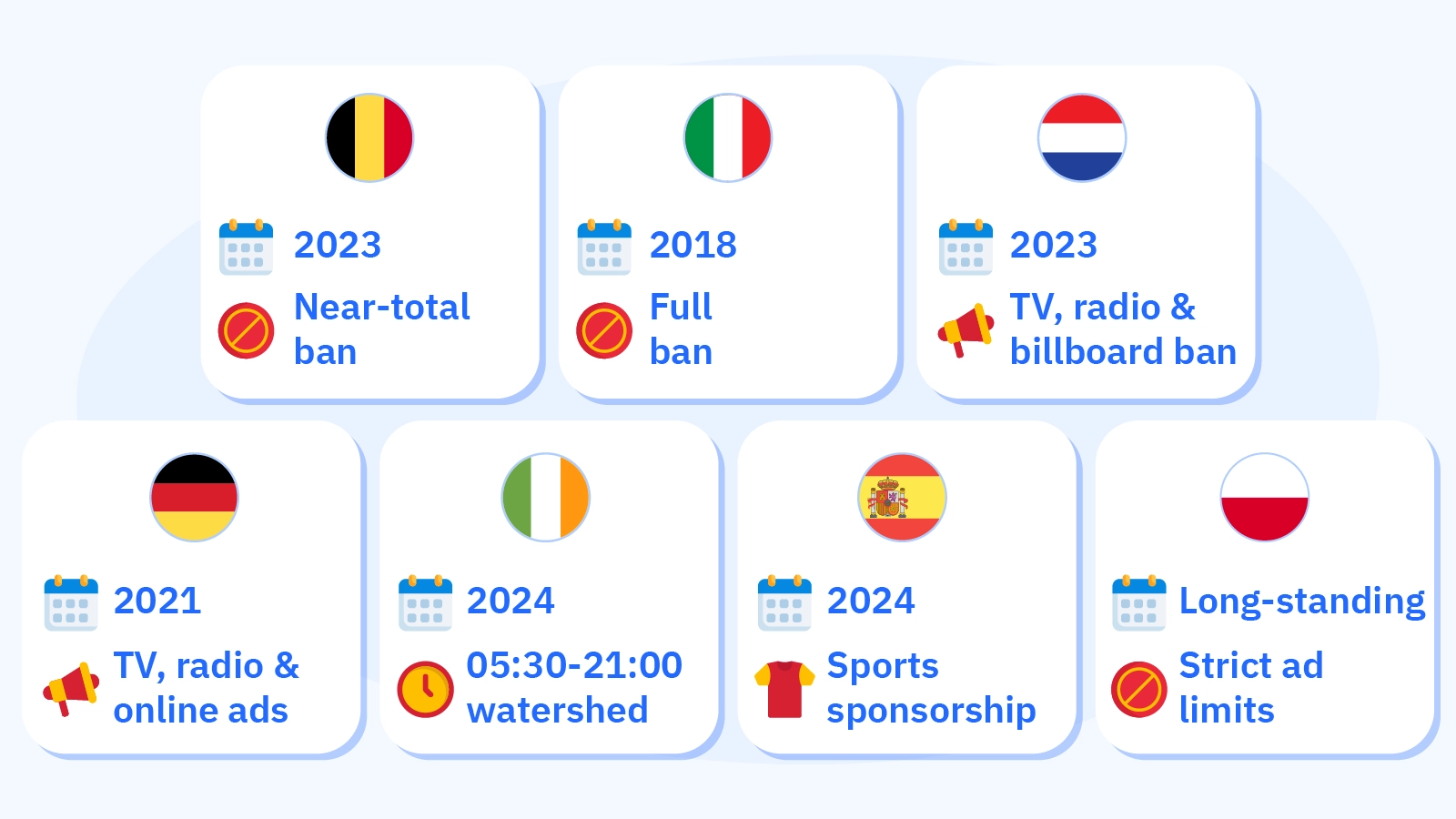
- Belgium imposed a near-total ban starting in 2023, and by 2025 all forms of advertising were banned in stadiums as well.
- Italy banned gambling advertising back in 2018 through the Decreto Dignità. The ban remained in force into 2026, even though the regulator attempted a review that’s still pending before the Court of Justice.
- The Netherlands has banned TV, radio, and billboard advertising since July 2023. The rules were recently extended to influencers as well, and there’s now talk of a total ban.
- Germany prohibits TV, radio, and online ads between 06:00 and 21:00. Advertising for live in-play betting isn’t allowed during matches either.
- Ireland introduced a 05:30–21:00 watershed through the Gambling Regulation Act 2024. Advertising for live betting, or athlete endorsements of it, isn’t permitted either.
- Spain lost part of Royal Decree 958/2020 following a 2024 Supreme Court ruling, but the ban on sports sponsorships held up and still applies.
- Poland has long restricted advertising and has even started criminalizing the promotion of unlicensed gambling, with penalties of up to 5 years in prison.
On top of all this, there’s the UK’s voluntary whistle-to-whistle ban and the Premier League’s decision to remove gambling logos from players’ shirts.
Current vs Predicted: A Side-by-Side View
We, the members of the CasinoAlpha team, have analyzed each country individually, gathered all the information, and created a table featuring only part of it.
After going through all the data, we can draw a simple conclusion. Countries that already have strict rules are unlikely to make many further changes. As for the others, we’ll have to wait and see what they do. Will they follow the same example?
| Country | What’s happening right now | Where it’s heading |
|---|---|---|
| Italy | Advertising banned under the Dignity Decree | Likely staying the same |
| Netherlands | Broad ad restrictions, influencers included | Could tighten further |
| Germany | Strict time limits for ads across media | More restrictions likely after 2026 review |
| Ireland | Strong ad rules + social media limits | Already quite stable |
| Spain | Sports sponsorship is banned | Probably staying the same, with a small chance of added limits |
| UK | Voluntary whistle-to-whistle rules, shirt sponsors disappearing from 2026/27 | Still unclear, could become law or stay voluntary |
| France | Some restrictions already in place, more being discussed | Possible future tightening |
We’re betting that Belgium, Ireland, and Norway will stay exactly as they are now. Spain and France are the unpredictable ones, where things could move fast. Still, we’d love to know what you think! Which country do you think will see the biggest changes? Let us know your answer in the comments section!
Why This Is Coming: Four Durable Drivers
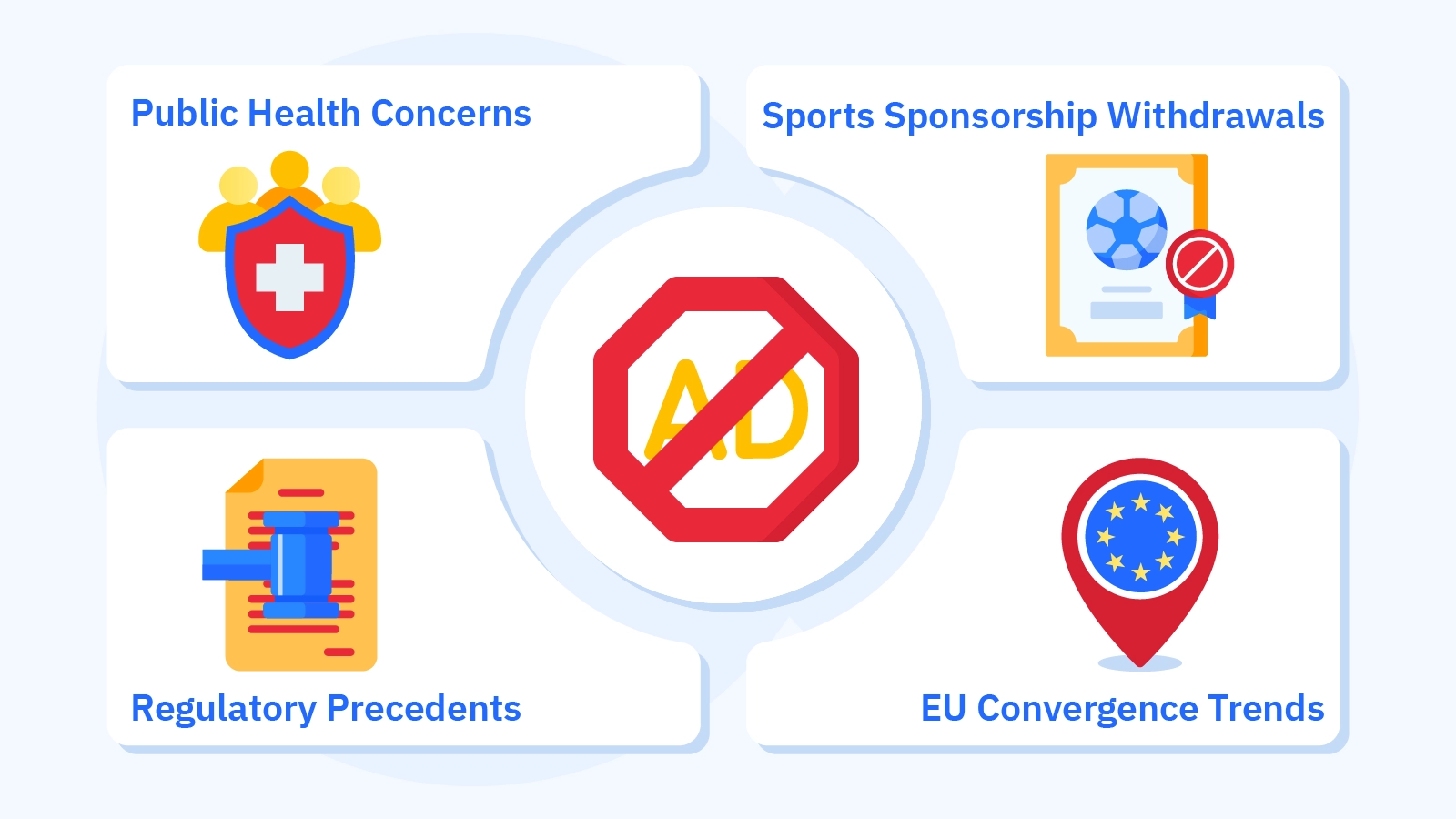
The CasinoAlpha team has been closely tracking these legislative changes, and one thing immediately jumped out at us. None of this looks accidental. If you look closely, you’ll notice that every government keeps repeating the same arguments.
It all generally starts with public health. European regulators have begun treating gambling ads the same way they treat tobacco or junk food. All of these affect the population as a whole, not just the people who choose to gamble. If gambling is treated as a public risk, then sport has to be reevaluated too, since it’s the main vehicle for promotion.
There’s also a concrete move worth mentioning here: the withdrawal of shirt sponsorships in the Premier League. Until now, the industry argued that sport couldn’t exist without gambling money. This move proves otherwise.
Once a precedent like this takes shape, it becomes much easier for other authorities to point to it. Ontario’s AGCO, for example, banned athletes and celebrities from appearing in iGaming ads back in 2024. One ban makes the next one easier to defend. We can see this clearly, given how much these reforms have multiplied in recent years.
At the end of all these moves, something happens that, officially, no one planned. The EU still doesn’t have a unified gambling law. Even so, countries are ending up with very similar rules, without being legally required to. What we don’t know for sure is whether a law like this will actually happen. What do you think? Let us know in the comments section!
Counter-Arguments (Honest Reading)
Our estimate is 65%, not 95%, and there are concrete reasons for that:
Sports and media depend on gambling advertising revenue. Lower-division clubs complained about the original timeline being unrealistic, and the English Football League managed to secure a longer compliance window.
Industry lobbying is well-funded and quite effective. Spain’s Supreme Court annulled key parts of Royal Decree 958/2020 in 2024, following challenges filed by operators.
In Belgium, challenges have already been filed, and Italy may end up softening its ban under pressure from the Court of Justice.
We believe there’s a real risk that these bans could push players toward the black market. Industry associations in the Netherlands and Portugal make the same argument. Total bans can drive players to migrate to unlicensed sites. We don’t support this outcome!
The UK’s whistle-to-whistle ban has had mixed results. Studies show the number of ads dropped, but it also led to workarounds ads now show up before and after matches, along with plenty of sponsorships.
If two or three of the reforms currently under discussion stall, the number of countries could end up lower than expected.
What This Means for Different Player Segments
Not everyone feels these changes the same way. Depending on how you play and where you usually find new operators, the impact looks pretty different, here’s what it means for each type of player.
Sports bettors: This is where we see the biggest change. As we mentioned earlier, front-of-shirt sponsorships are disappearing. Starting in 2026, perimeter advertising in Belgian stadiums has already been removed. We’re also seeing the whistle-to-whistle ban spread further and further.
Casino players: Visibility for new brands drops significantly, and discovering new operators shifts almost entirely to online searches.
VIP players: Marketing rules are getting stricter, and we can clearly see this happening. Sweden now requires explicit consent before re-contacting closed accounts. Most jurisdictions restrict communication to account holders who’ve explicitly opted in.
Those who discover operators through affiliates (like you, reading this article): The only real change is that, as the number of ads shrinks, quality matters more and more.
Timeline Milestones
To give you a clearer picture of how fast things are moving, we’ve laid it all out year by year, through 2029:
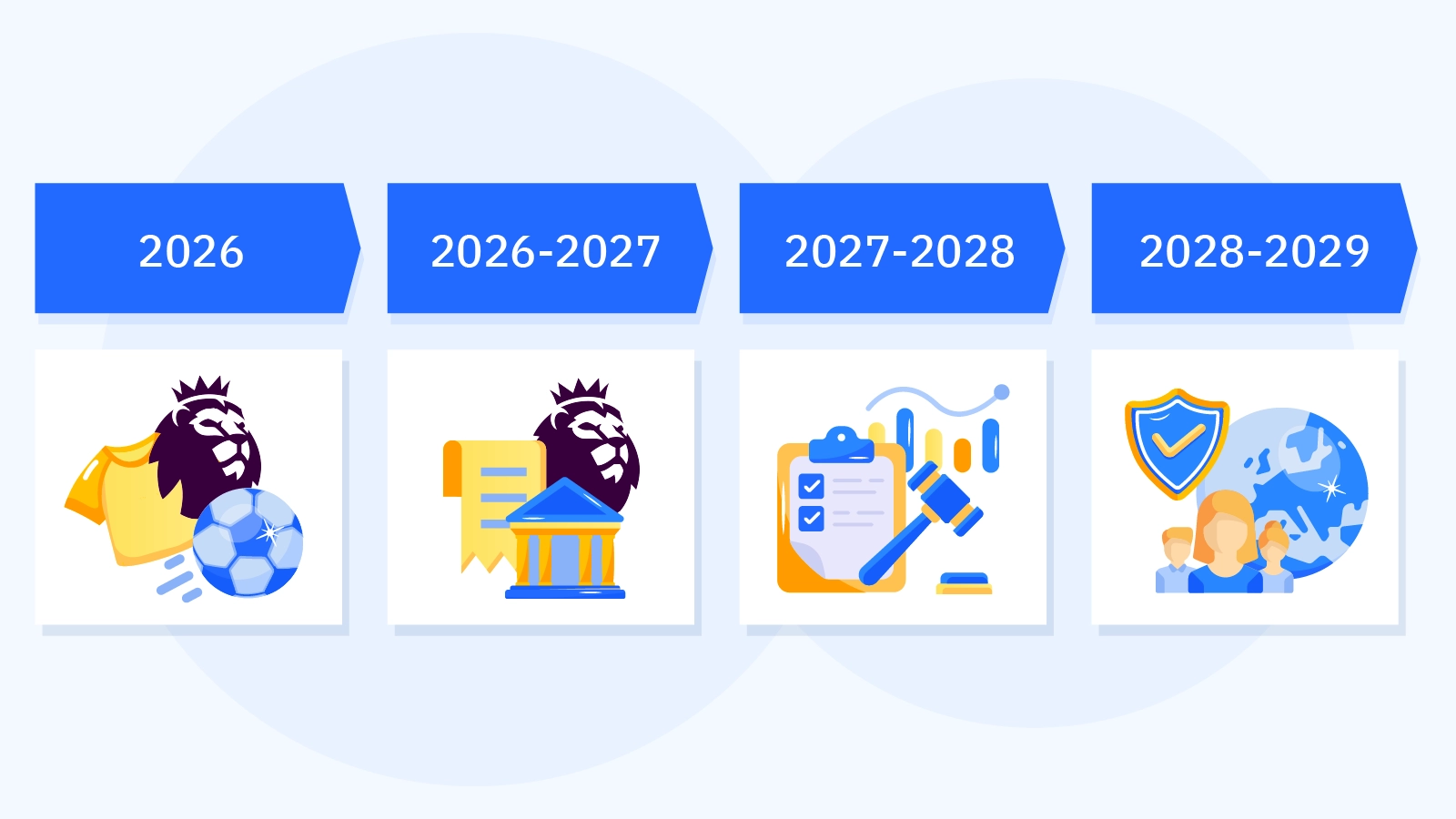
2026: This is the Premier League’s last season with gambling sponsorships on player shirts. Denmark’s whistle-to-whistle reform has also taken effect, and Ireland begins implementing the Gambling Regulation Act 2024.
2026-2027: The ban on shirt sponsorships becomes active in the Premier League starting in August. In this same period, Portugal is set to vote on Bills 220/221, while France’s ANJ recommendations move forward toward formal statutory regulation.
2027-2028: During this period, Germany’s GlüStV review report is also expected to be published. EFL clubs reach the compliance deadline set earlier, and we’re also expecting a ruling from Belgium’s Constitutional Court that will clarify the maximum threshold allowed for national bans.
2028-2029: This final stretch is about the statutory implementation of the toughest reforms. We believe this is the point at which the threshold of 10 countries with clear restrictions will likely be reached.
What Players Should Do Today
There’s nothing you need to do right now, but it doesn’t hurt to stay informed. This article gives you a clear prediction for the years ahead.
You can start by bookmarking your favorite sites, reading reviews you trust, and taking advantage of the fact that advertising still exists and can help you discover new operators. As traditional ads start disappearing, finding new casinos will get harder. You’ll see we were right, a few years from now!
One piece of advice we can give you is to check the license of every operator you’re considering. As discovering new casinos gets harder, your own due diligence becomes the main form of protection you have.
Another thing to expect has to do with bonuses. Unfortunately, they’ll become less visible. Welcome-offer marketing is among the first things affected by these new reforms. You’ll have to go find the best deals yourself!
Gambling itself isn’t going away, but advertising will keep getting quieter as time goes on.
Sources:
- Belgian Gaming Commission: Royal Decree on Advertising. https://gamingcommission.be/en/rd-advertising
- PowerPlay (Sports Law): Belgian ban on gambling advertising in the sports sector. https://powerplay.be/belgian-ban-on-gambling-advertising-in-the-sports-sector/ [
- DLA Piper: Removal of the Italian gambling advertising ban (2026). https://www.dlapiper.com/en-us/insights/blogs/mse-today/2026/removal-of-the-italian-gambling-advertising-ban-why-italys-football-authority-is-now-pushing
- iGaming Business: KSA emphasises compliance to licence-holders ahead of 2026 World Cup. https://igamingbusiness.com/legal-compliance/compliance/ksa-emphasises-compliance-licence-holders-2026-world-cup/
- Irish Statute Book: Gambling Regulation Act 2024. https://www.irishstatutebook.ie/eli/2024/act/35/enacted/en/html
- State Treaty on the New Regulation of Gambling in Germany (GlüStV 2021), English translation: https://gamblingcompliance.vixio.com/sites/default/files/inline-files/State%20Treaty%20on%20the%20New%20Regulation%20of%20Gambling%20in%20Germany-unofficial%20English%20translation.pdf
- Osborne Clarke: Current framework on gambling advertising in Spain after Supreme Court’s partial annulment. https://www.osborneclarke.com/insights/what-current-framework-advertising-gambling-activities-spain-after-supreme-courts-partial
- iGaming Business: French regulator ANJ calls for whistle-to-whistle gambling advertising ban. https://igamingbusiness.com/legal-compliance/regulation/french-regulator-anj-whistle-to-whistle-ban-gambling-advertising/
- Casino Barometer: Sweden steps up enforcement on unlicensed gambling. https://www.casinobarometer.com/sweden-steps-up-enforcement-on-unlicensed-gambling/
- Alcohol and Gaming Commission of Ontario: AGCO to ban athletes in Ontario’s iGaming advertising. https://www.agco.ca/en/news/agco-ban-athletes-ontarios-igaming-advertising-protect-minors
- Sky Sports: Premier League clubs agree to withdraw gambling sponsorships on front of shirts. https://www.skysports.com/football/news/11095/12856367/premier-league-clubs-agree-to-withdraw-gambling-sponsorships-on-front-of-shirts
- AffPapa: Denmark set to reform gambling advertising rules by 2027. https://affpapa.com/denmark-set-to-reform-gambling-advertising-rules-by-2027/
- Lexology: Portuguese parliament discusses near-ban on gambling advertising. https://www.lexology.com/library/detail.aspx?g=fed6d04b-1b54-460d-88a2-746779b6bc89
- Health Promotion International (Oxford Academic): Insights into the Belgian gambling advertising ban. https://academic.oup.com/heapro/article/39/4/daae116/7746125
- iGaming Business: European gambling regulation’s quiet convergence. https://igamingbusiness.com/legal-compliance/european-gambling-regulation-quiet-covergence-regulatory-harmonisation/