


Japan Online Casino Legality: Rules Players Should Know

We have paid partnerships with the online casino operators featured on our site. We may also earn commissions when users click on certain links. However, these partnerships do not affect our reviews, recommendations, or analysis. We remain impartial and committed to delivering unbiased gambling content.
Learn moreJapan has one of the strictest legal frameworks around gambling. Under the Penal Code, casino gambling is technically banned, but there are a few small exceptions here too. Pachinko parlors can be found on nearly every street corner, and government-run sports betting is fully legal.
Online gambling gets treated with zero tolerance, and Japan has been tightening enforcement over the past few years. The CasinoAlpha team has taken a close look at this topic, and in this article, we’ll show you how enforcement has changed in Japan and what you can expect in the years ahead.
- What’s Legal and What’s Illegal in Japan
- Pachinko and the Cultural Roots of Reform Resistance
- The Offshore Reality: Why Players Still Access International Casinos
- Enforcement in Japan: Who Actually Gets Prosecuted
- Integrated Resorts: Osaka’s Casino Timeline
- Will Japan Regulate Online Gambling? Our Outlook
- The Bottom Line for Players
- How We Verified This
What’s Legal and What’s Illegal in Japan
Japanese gambling laws look simple on paper: casino gambling is illegal. The reality is a bit more complicated! There are a few solid exceptions that have existed for decades, like sports betting and pachinko parlors. On the flip side, online casino gambling is strictly banned, no matter what license the casino holds.
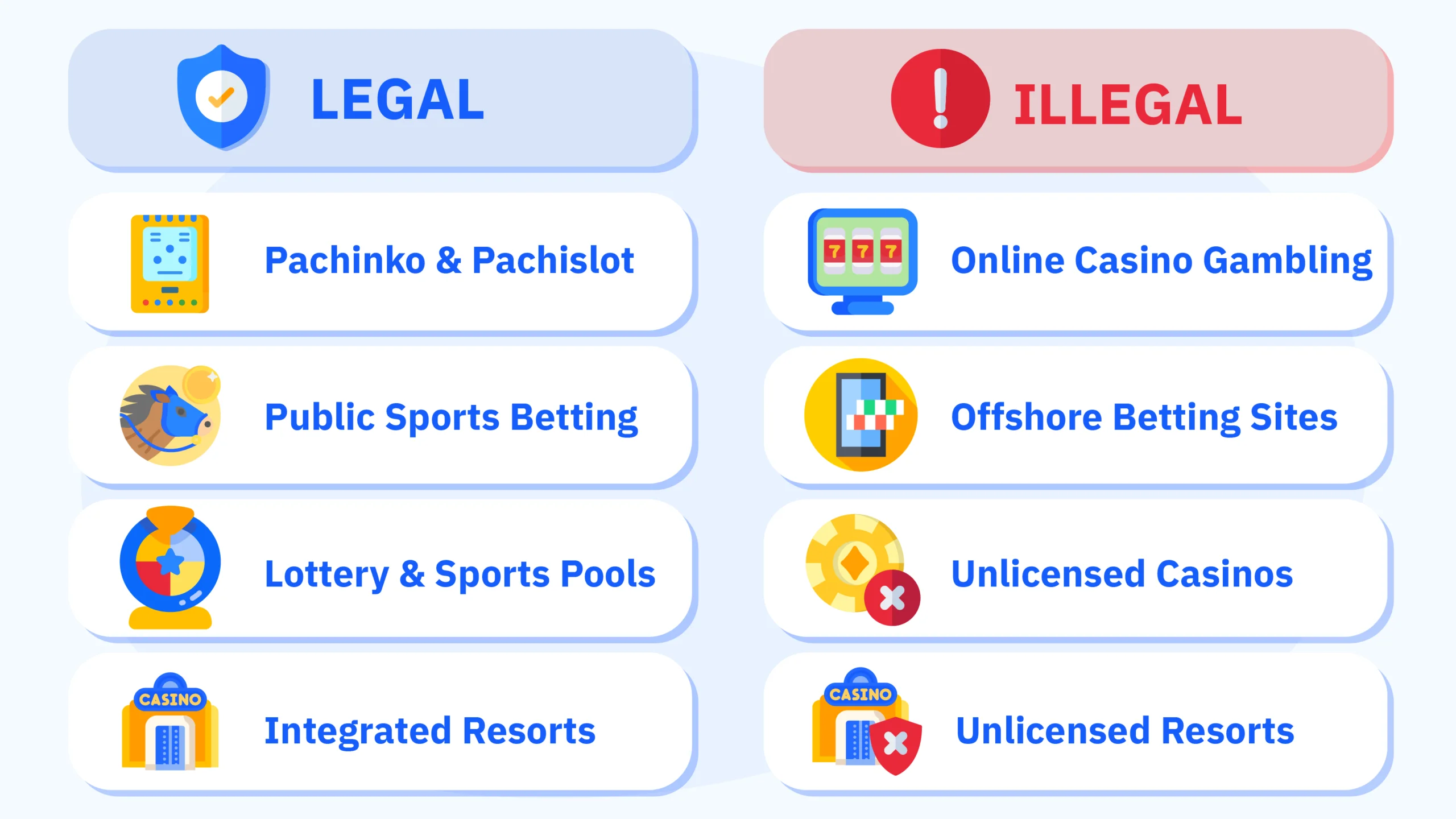
The CasinoAlpha team has put together a table with everything you need to know:
| Activity | Legal Status |
|---|---|
| Casino gambling, including future Integrated Resort casino floors | Off-limits everywhere, except inside licensed Integrated Resorts once they open |
| Online casino gambling | Banned outright for operators and players alike, no matter where the site is licensed |
| Pachinko and pachislot | Legal |
| Public sports betting | Fully legal, licensed and government-run |
| National lottery and sports pools | Legal |
Pachinko and sports betting are about as safe as it gets. Online slots are a different story entirely, you’re looking at actual legal exposure, not just a technicality nobody enforces.
What type of game do you prefer? We’re looking forward to hearing from you in the comments section!
Pachinko and the Cultural Roots of Reform Resistance

Pachinko is the best example of how Japan separates the letter of its gambling law from the reality of a mass-market industry. Players buy small steel balls, which they feed into a pinball-style machine. Balls won can be exchanged right inside the parlor for tokens called special prizes.
These tokens have no cash value on the premises, but they can be sold for cash at a separate vendor that’s entirely independent from a legal standpoint. So what we end up with is a three-shop system: the parlor, the prize, and the off-site exchange counter.
This system has let pachinko operate for decades without being classified as gambling, even though, in practice, the player was walking away with a payout from what’s essentially a slot machine.
The industry is still large, but we’re seeing it shrink steadily combined pachinko and pachislot revenue has fallen to roughly half of what it was two decades ago. Right now, the number of parlors has dropped from over 12,000 in the early 2000s to just 7,600 today.
So why is this happening?
Younger consumers are shifting more and more toward mobile gaming, and that’s the main reason parlor numbers keep declining. Even so, even in decline, pachinko remains economically significant. You can see that through the jobs it provides in parlors, machine manufacturing, and local tax revenue.
Formally regulating online casino gaming could raise some uncomfortable questions. Why hasn’t a similarly structured activity, one that also generates money, ever been treated as gambling? We’d say that’s exactly why politicians have avoided reopening this legal framework.
The Offshore Reality: Why Players Still Access International Casinos
You should know that online casino gambling is illegal in Japan, under Article 185. This applies no matter where the operator is licensed.
Japanese courts have consistently held that if you, as a player, are physically located in Japan when you place a bet, domestic law applies, even if the platform holds a legitimate license.
From a practical standpoint, that hasn’t stopped a large number of residents from playing on offshore sites. According to National Police Agency estimates, roughly 3.3 million Japanese residents have gambled on offshore online casinos at some point. Generally speaking, we’re talking about people between 20 and 30 years old.
This large-scale access to offshore platforms exists because, over time, enforcement has focused more on sites and advertisers than on prosecuting individual players. That balance, though, has gradually started to shift, as you can see.
Enforcement in Japan: Who Actually Gets Prosecuted
To really understand how the law works in Japan, you need to know a few concrete facts. For many years, Japanese law only went after those offering online gambling services, meaning unlicensed casinos or offshore sites. You, as a player, weren’t held accountable.
With the new revised law that took effect on 25 September 2025, advertising, affiliate links, and review sites are now completely banned. What’s more, celebrities aren’t allowed to promote gambling either. Government institutions are also required to run public awareness campaigns on the illegality of gambling.

With this change, National Police Agency data shows a record 317 individuals targeted by enforcement action. Most of these cases are tied to online casino use and even involve well-known entertainers and athletes. Police have also arrested operators, affiliates, and payment processors, with one case involving roughly 670 customers and close to seventy billion yen.
Unlike operators, who can even face prison sentences under Article 186, players are held accountable under the lesser offense, meaning they can face fines of up to 500,000 yen. So we can’t deny that player risk has also increased since 2025, but it’s operators and payment intermediaries who remain exposed to the harsher penalties.
Integrated Resorts: Osaka’s Casino Timeline
The 2018 Integrated Resorts Act created a limited legal path allowing licensed land based casinos to operate inside large resort complexes. There are 3 such locations. Osaka is clearly the furthest along on this front. MGM Resorts and Orix Corporation have already started construction on Yumeshima island, back in April 2025.
According to current public estimates, construction will be completed around summer 2030, with an opening planned for that same autumn. That’s indeed a later date compared to the 2026-2029 window discussed in the earlier planning stages.
Keep in mind that Integrated Resort license only cover land-based casinos. Online casinos don’t fall into this category. The two tracks, land based casinos and online casinos, remain completely separate under Japanese law. If anything changes, you’ll find the latest updates on our site!
Will Japan Regulate Online Gambling? Our Outlook
CasinoAlpha’s experts have analyzed the direction of policy from 2024 to now, and we believe it’s unlikely Japan will introduce a regulated gambling market before 2030.
Instead of loosening the rules, lawmakers actually tightened the legal framework further in 2025. In fact, the Ministry of Internal Affairs and Communications is considering blocking illegal gambling sites at the internet provider level. This model is already used in some European countries. The discussion started around the possible legalization of sports betting, but even that met significant opposition.
From our point of view, this outlook is fairly solid, but not 100% guaranteed. Looking back, Japan’s gambling policy has shifted before. Even the Integrated Resorts Act, which we mentioned above, took decades of discussion before it was approved. So we’re not ruling out the possibility of a longer-term change. For now, though, all the signs point toward continued prohibition, not a step toward legalization.
The Bottom Line for Players
You need to remember the following information! Japan’s gambling framework is genuinely restrictive, though there are a few small exceptions: pachinko, the national lottery, and public sports betting. That said, these exceptions are limited, and there’s little chance they’ll ever expand.
Offshore online casinos will keep being accessed on a large scale, even though they’re illegal. Even so, we have to acknowledge that enforcement has clearly hardened since 2025, and both operators and players can face real consequences.
MGM Osaka’s opening, planned around 2030, won’t change anything for online players, since Integrated Resort license only cover land-based casinos.
If you’re considering using an offshore online casino in Japan, we’d say think twice! You’re taking on a real legal risk!
How We Verified This
Our team checked all the citations from the Penal Code, using the official Japanese Law Translation database. We went further and also looked into 2025 and 2026 articles about MGM Osaka’s construction timeline, cross-checking them against National Police Agency data reported in the press. Whenever sources disagreed with each other, we relied on the most recent information, as well as the most well-documented.
Gambling, including offshore online gambling accessed from Japan, carries legal risk as well as financial risk. If you or someone you know is struggling with gambling, support is available; in Japan, resources include local mental health and welfare centers and national helplines for gambling-related harm. Please gamble responsibly and be aware of the laws that apply in your own jurisdiction.
This article is provided for general informational purposes only and does not constitute legal advice. Laws referenced here can change, and readers should confirm current requirements with an official source or qualified legal professional before making decisions based on this content.
F.A.Q.
Is it illegal to play at an online casino in Japan?
Yes. Online casino gambling is illegal under Penal Code Article 185 for anyone physically in Japan, no matter where the operator holds its license.
Can Japanese players be fined or arrested for using offshore casinos?
Yes, and it’s becoming more common. National Police Agency data shows a record 317 individuals faced enforcement action in 2025, most of them tied to online casino use. Players typically end up with fines, while operators and payment processors face much harsher penalties.
Why is pachinko legal if casino gambling is not?
Because winnings aren’t paid out in cash on the premises they’re handed over as tokens, which can then be exchanged for cash at a separate shop just outside. This three-shop system has been tolerated for decades as its own distinct category, rather than as an exception carved out under the Penal Code.
When will Japan's first casino open?
MGM Osaka broke ground in April 2025, with an opening targeted for autumn 2030 and it’ll be a land-based casino only, not online.
Will Japan legalize online casinos?
We think it’s unlikely before 2030. Back in September 2025, Japan actually tightened restrictions instead of moving toward legalization, and right now there’s no real sign that legalizing online casino gaming is on the table.